
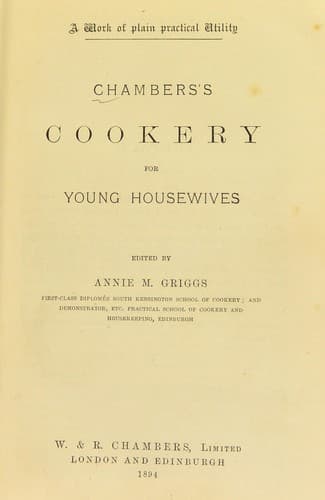
Chambers's cookery for young housewives
1894Annie M. Griggs · 95 readable pages · 294 recipe records · general household cookbook
From the librarian's dossier · AI-generated, grounded in the scanned text
Chambers's Cookery for Young Housewives (1894) is a practical instructional manual by Annie M. Griggs, published by the Edinburgh and London firm W. & R. Chambers as part of a broader educational and domestic economy catalog. Aimed at young women setting up their first households, the book moves systematically through the core techniques of Victorian domestic cookery: roasting, broiling, frying, boiling, and stewing meats and game, before expanding into soups, sauces, fish and shellfish, vegetables, pastry, puddings, preserving, invalid cookery, baking, and household management. A notable feature is its strong Scottish thread, with dedicated treatment of haggis, hotch potch, cockie-leekie, and sheep's head alongside more general British fare. The book closes with sections on carving, servants' duties, table setting, and care of kitchen equipment, reflecting its function as both a cookery guide and a primer in household governance. With around 294 anchored food records, an alphabetical index, and period advertisements for kitchen goods and companion publications, this is a compact but comprehensive instructional text. Modern readers will find it a window into the training expected of a Victorian housewife, blending recipe instruction with economy, technique, and domestic discipline throughout.
The book is organized as a graduated course in domestic cookery rather than an alphabetical dictionary. It begins with fundamental meat cookery methods (roasting, broiling, frying, boiling, stewing) in sections 2 and 3, then proceeds to soups, Scottish specialties, and sauces in section 4, fish, shellfish, curries, and vegetables in section 5, potatoes, salads, and pastry in section 6, puddings, jellies, jams, and invalid cookery in section 7, more invalid dishes and cake-baking plus egg and cheese dishes in section 8, and household service topics (curing, carving, servants' duties, table setting) in section 9. Section 10 closes the volume with a comprehensive index and period advertisements. The progression suggests a teaching sequence moving from basic technique to more specialized and managerial knowledge.
Recipes from this book
294 records extracted from the text, showing the first 50 in reading order. Each links to a modern interpretation.
Read the book
95 readable pages. A dot marks pages with recipe records.