
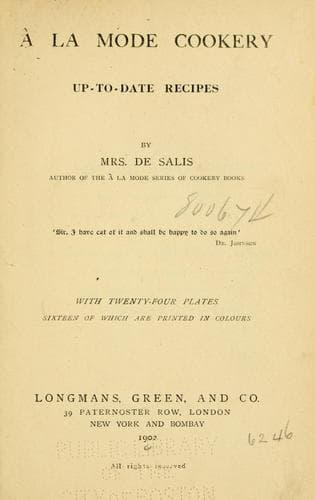
À la mode cookery
1902Harriet Anne de Salis · 91 readable pages · 346 recipe records · Victorian and Edwardian haute cuisine household cookbook with reference appendix
From the librarian's dossier · AI-generated, grounded in the scanned text
À la mode cookery (1902) by Harriet Anne de Salis is a late Victorian and Edwardian recipe collection aimed at ambitious households and professional-adjacent cooks seeking fashionable, restaurant-style dining at home. Framed in its introduction as an up-to-date guide with color plates, the book moves through soups, fish, elaborate cold and hot entrees, poultry and game, vegetables, sauces, sweets, and savouries before closing with a substantial reference section of kitchen hints, table-laying instructions, and a culinary glossary. The recipes lean heavily toward haute cuisine presentation: aspic work, molded dishes, forcemeats, and ornamental garnishing with truffles, pistachio, and colored jellies appear throughout. Many dishes carry aspirational or fashionable names invoking places, titles, and contemporary figures, reflecting the era's taste for spectacle at the table. Alongside the showpiece entrees, the book also grounds readers in fundamentals: stockmaking, roasting and boiling technique, sauce bases, and vegetable cookery. The final sections shift from recipes to practical kitchen management and formal service, making this as much a manual of household and dining protocol as a cookbook. For the modern reader, it offers a detailed window into how affluent Edwardian kitchens balanced technical rigor with theatrical presentation, and how cookery writing of the period combined recipe instruction with etiquette and reference material in a single volume.
The book proceeds from foundational categories toward increasing culinary complexity and then into reference material. It opens with soups and fish (section 1), moves into elaborate fish and shellfish presentations (section 2), then covers roasting, boiling, frying, stewing, grilling, and braising techniques alongside cold and hot entrees (section 3). Sections 4 and 5 continue with meat, poultry, and game entrees before turning to vegetable cookery and the fundamentals of sauce-making. Section 6 presents classical sauces followed by an extended run of sweets, and section 7 continues with cold desserts, frozen preparations, and savouries or hors d'oeuvres. Section 9 departs from recipe presentation to cover essential kitchen guidance: fire and range management, foundational preparations like batters and panada, kitchen hints, table-laying and service procedure, and a glossary of culinary terms from Abaisse to Zest. Section 10 is the book's index, showing final entries on veal, vegetable marrow, venison, and wild duck along with publication and library-stamp information. Note that section 8 is absent from the provided material, so a gap exists between the savouries content of section 7 and the reference matter of section 9.
Recipes from this book
346 records extracted from the text, showing the first 50 in reading order. Each links to a modern interpretation.
Read the book
91 readable pages. A dot marks pages with recipe records.