
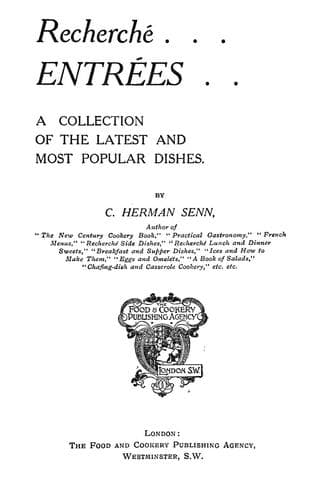
Recherché entrées
1907Charles Herman Senn · 85 readable pages · 248 recipe records · professional French haute cuisine recipe reference
From the librarian's dossier · AI-generated, grounded in the scanned text
Recherché Entrées (1907) is a specialized French-style culinary reference by Charles Herman Senn, devoted entirely to the entrée course as understood in classical haute cuisine. Rather than a general household cookbook, it is a professional-facing manual that treats entrées as composed dishes built from sauces, garnishes, and carefully assembled elements rather than simple cuts of meat. The book opens with instructional material on the theory and structure of entrées within a formal dinner, then proceeds through an extensive catalog of recipes organized by main ingredient: farinaceous dishes, fish, veal, beef, mutton and lamb, poultry, ham, and game. It closes with a substantial sauce and auxiliary section that underpins many of the preceding recipes. With roughly 250 anchored food records and a stated scope of thousands of recipes, this is a dense technical reference intended for chefs and serious kitchen professionals of the era. Modern readers will find it a window into the elaborate presentation standards, French technical vocabulary, and layered preparation methods (aspic work, chaud-froid, forcemeats, timbales) that defined upscale Continental cooking at the turn of the twentieth century. It rewards readers interested in culinary history, classical technique, or the formal structure of Edwardian fine dining.
The book is organized by main ingredient category rather than by course or meal. Section 1 introduces the concept of entrées, explains the hot/cold distinction, and covers decoration and menu selection before moving into recipes for light entrées such as timbales, soufflés, and tartlets. Section 3 covers farinaceous dishes and fish entrées, followed by the start of veal preparations. Section 4 continues veal and introduces beef. Section 5 covers further beef dishes (notably a run of tournedos variations) and mutton/lamb. Sections 6 and 7 cover poultry and ham, then continue into poultry and game. Section 8 concludes the game entrées and transitions into a dedicated sauces and auxiliaries section. Section 9 extends this sauce reference with classic and composed sauces, aspic jellies, and cold dressings, and closes with a general index describing the book's overall recipe categories.
Recipes from this book
248 records extracted from the text, showing the first 50 in reading order. Each links to a modern interpretation.
Read the book
85 readable pages. A dot marks pages with recipe records.