
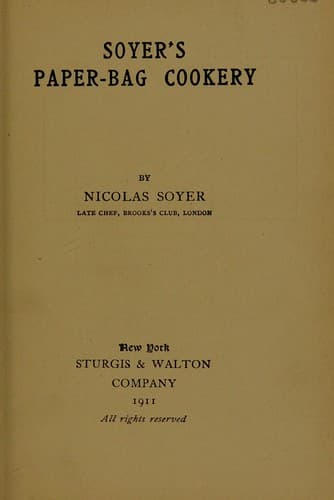
Paper-bag cookery
1911Nicolas Soyer · 42 readable pages · 126 recipe records · single-method cookbook (paper-bag cookery)
From the librarian's dossier · AI-generated, grounded in the scanned text
Paper-bag Cookery (1911) is Nicolas Soyer's practical guide to a novel cooking method he spent fifteen years perfecting: sealing food in specially prepared grease-proof paper bags and cooking them on a broiler in an ordinary oven. Soyer, writing for an American edition of his book, presents this as a hygienic, economical, and flavor-preserving alternative to conventional boiling, roasting, and stewing. The book opens with the author's account of his experiments, from early failures with fish wrapped in ordinary foolscap paper to a public competition that validated the technique, followed by general directions, oven temperatures, and a time table for cooking various foods. The bulk of the book consists of recipes organized by category: fish, entries (meat dishes), poultry, roasts, vegetables, savories, sweets, cold meat cookery, and breakfast dishes. Throughout, Soyer argues that sealing food in bags retains natural juices, nutrients, and soluble salts that are lost in traditional cooking. The book closes with a broader justification of the method's scientific and economic advantages, followed by a manufacturer's advertisement for the Union Cooking Bags product needed to practice the system, complete with a list of authorized American sellers. This is a specialized, single-method cookbook of historical interest to readers curious about early twentieth-century culinary innovation and commercial cookbook publishing.
The book begins with an introduction describing the origin and development of the paper-bag method, followed by general directions, oven temperature guidance, and a time table (section 1). Recipes are then organized by category across the following sections: fish dishes begin section 1 and continue into section 2 alongside entries (meat dishes) and poultry (section 2). Section 3 covers roasts, vegetables, savories, sweets, cold meat cookery, and breakfast dishes. Section 5 shifts from recipes to a scientific and economic justification of the method, concluding with a manufacturer's advertisement for Union Cooking Bags and a list of selling agents across American cities.
Recipes from this book
126 records extracted from the text, showing the first 50 in reading order. Each links to a modern interpretation.
Read the book
42 readable pages. A dot marks pages with recipe records.