
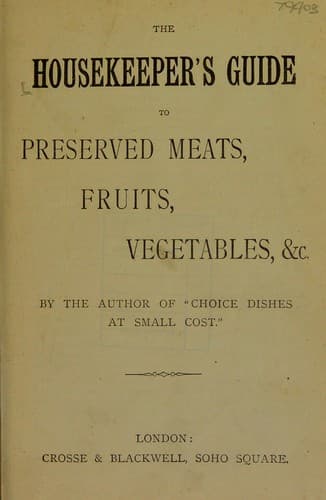
The housekeeper's guide to preserved meats, fruits, vegetables, &c
1880238 readable pages · 250 recipe records · alphabetical culinary dictionary focused on preserved and tinned provisions
From the librarian's dossier · AI-generated, grounded in the scanned text
This 1880 guide is not a conventional cookbook of recipes built from scratch, but a practical manual devoted entirely to the use of preserved, tinned, potted, and bottled foods that had become widely available to Victorian households. Organized as an alphabetical culinary dictionary running from absinthe to Worcester sauce, it instructs readers, largely middle-class housekeepers, on how to open, heat, garnish, and transform commercial provisions into presentable dishes. The anonymous author repeatedly frames preservation technology as a democratizing force, bringing distant luxuries like foie gras, truffles, and turtle soup within reach of ordinary tables, while also serving practical needs such as provisioning yachts, country houses, and bachelor lodgings. Entries mix commentary on named commercial brands (Crosse and Blackwell, Halford's, Soyer's sauces) with detailed technique: proper temperatures for frying, methods for clarifying stock, advice on invalid cookery, and warnings against culinary excess or unsafe substitutions. Readers today will find a window into the commercial food culture of the period, complete with brand loyalty, class-conscious economizing, and an emphasis on visual presentation. It is best approached less as a set of recipes to cook from directly and more as a period document showing how convenience foods were marketed, understood, and incorporated into daily domestic life.
The book is arranged as an alphabetical encyclopedia of preserved and tinned foodstuffs, opening with a preface and introduction (section 1) that state its purpose and general principles. From section 2 onward, entries proceed alphabetically by ingredient or product name, covering everything from absinthe and anchovies through fruits, meats, sauces, and vegetables, concluding with vinegar, walnuts, and Worcester sauce in section 24. Each entry typically describes the preserved product, how to judge quality or select brands, and offers one or more recipes or serving methods built around it. Recurring cross-references and headings (such as repeated returns to sauces, jellies, and tinned soups) suggest the dictionary format was designed for lookup rather than linear reading.
Recipes from this book
250 records extracted from the text, showing the first 50 in reading order. Each links to a modern interpretation.
Read the book
238 readable pages. A dot marks pages with recipe records.