
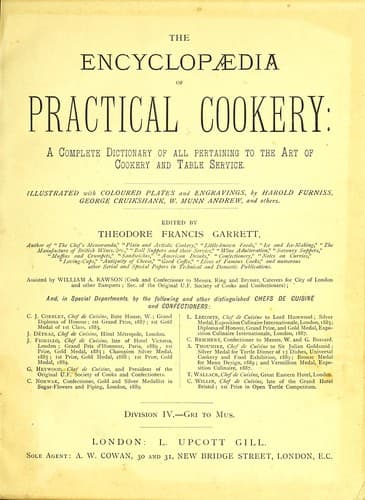
The encyclopaedia of practical cookery
1892Theodore Francis Garrett, William A. Rawson · 577 readable pages · 1,499 recipe records · alphabetical culinary dictionary
From the librarian's dossier · AI-generated, grounded in the scanned text
The Encyclopaedia of Practical Cookery is a massive late-Victorian culinary reference, compiled under the editorship of Theodore Francis Garrett with William A. Rawson, and issued in 1892. Structured as an alphabetical culinary dictionary, this surviving portion runs from the letter G through the letter M, offering the modern reader a dense, encyclopedic tour of Victorian professional and household cookery. Entries range from workaday staples like herring, ham, and macaroni to elaborate game dishes such as grouse, hare, and larks, alongside sweets, preserves, beverages, and technical culinary terms. The book blends dictionary-style definitions of ingredients and techniques with hundreds of numbered recipes contributed by named chefs and confectioners of the era, illustrating both haute cuisine and everyday fare. Readers will encounter extensive treatment of game birds and offal, meticulous curing and preservation instructions, and a striking abundance of lemon and lobster recipes that reveal Victorian taste for variety and elaboration within a single ingredient. The scope reflects an ambition to serve as a comprehensive professional and domestic reference, covering not only food but auxiliary topics like kitchen equipment, ice storage, and pantry management. This dossier draws only on the anchored records and section summaries provided, which document roughly 1,499 food-related entries and a handful of medicinal ones embedded throughout the text.
The book is organized as an alphabetical culinary dictionary, moving letter by letter through ingredients, dishes, and techniques. Within each letter, entries are further subdivided by ingredient or dish, often with dozens of numbered recipe variations grouped under a single heading (as with grouse, hare, ham, lemons, lobster, and macaroni). Headings frequently include cross-references to related processes, sauces, or utensils described elsewhere in the encyclopedia. Sections combine narrative explanation (natural history of an ingredient, selection criteria, preservation methods) with sequential recipe lists, and some sections mix multiple unrelated letter entries when topics are brief (such as kidneys, ketchup, and kid appearing together, or medlar and melon closing out the letter M material). The pagination is synthetic and sections are not evenly sized: some entries like lemon and lobster span multiple sections due to their extensive recipe counts.
Recipes from this book
1,499 records extracted from the text, showing the first 50 in reading order. Each links to a modern interpretation.
Read the book
577 readable pages. A dot marks pages with recipe records.