
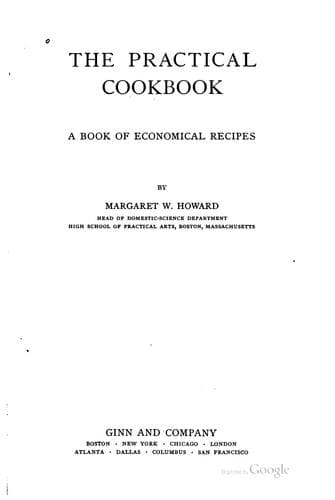
The practical cookbook
1917Margaret W. Howard · 67 readable pages · 285 recipe records · general household cookbook
From the librarian's dossier · AI-generated, grounded in the scanned text
The Practical Cookbook, published in 1917 by Margaret W. Howard, is a comprehensive American household cookbook that moves from basic nutritional theory to a full range of everyday cookery. It opens by explaining food classifications (proteids, carbohydrates, fats and oils, mineral salts, and water) to ground the home cook in the era's understanding of nutrition, then proceeds through beverages, vegetables, cereals, breads, baked goods, eggs, meats, poultry, fish, shellfish, pastries, frozen desserts, preserving, and invalid cookery. With 285 anchored food records spread across its six sections, the book reads as a systematic kitchen reference rather than a themed or narrative cookbook. It reflects domestic science priorities of the period, emphasizing exact measurement, proper equipment handling, seasonal treatment of vegetables and fruits, and attention to cost and food value. Its scope extends from plain boiled potatoes and stewed fruit to candies, ice creams, canned preserves, and fluid diets for the sick, suggesting a household expected to handle everything from daily meals to nursing care. Modern readers approaching this book should expect a reference work organized by course and ingredient rather than a book meant for cover-to-cover reading, offering a detailed picture of what an American cook in 1917 was expected to know and prepare.
The book is organized into six sections that proceed from foundational knowledge to specialized categories. Section 1 opens with an introduction to food chemistry and measurement before moving into beverages, fruits, vegetables, soups, and potatoes. Section 2 continues with potato variations, cereals, rice, macaroni, sauces, and yeast breads. Section 3 covers steamed puddings, muffins, biscuits, batter puddings, cookies, cakes, candies, frostings, sauces, and simple milk and cheese dishes. Section 4 addresses egg dishes and egg desserts, salad dressings and salads, and an extensive meat section covering roasting, broiling, boiling, and made dishes. Section 5 focuses on poultry, fish, shellfish, and meat substitutes using nuts and legumes. Section 6 closes with pastries and pie fillings, frozen desserts, canning and preserving, jelly-making, pickling, invalid cookery, and a final miscellany of baked goods and savory dishes. The organization follows headings by food category and cooking method rather than by meal or occasion.
Recipes from this book
285 records extracted from the text, showing the first 50 in reading order. Each links to a modern interpretation.
Read the book
67 readable pages. A dot marks pages with recipe records.