
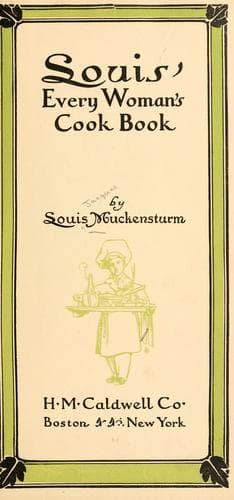
Louis' every woman's cook book
1910Louis Muckensturm · 60 readable pages · 207 recipe records · professional-style French-influenced American cookbook
From the librarian's dossier · AI-generated, grounded in the scanned text
Louis' Every Woman's Cook Book (1910) is a professional-grade culinary manual by Louis Muckensturm, presented to American housewives but rooted firmly in French haute cuisine practice. Rather than a simple household guide, it offers an ambitious tour through table service protocols, elaborate appetizers, stocks and soups, fish and shellfish cookery, sauces, poultry and game entrees, salads, and finally leftover dishes, sweet desserts, and a glossary of culinary terms. With 207 anchored food records, the book demonstrates remarkable range, from canapes of caviar and foie gras to consomme garnishes, sauce Espagnole, and Duckling a la Portugaise. The recipes consistently reflect formal restaurant-style technique: larding, glazing, forcemeat preparation, and elaborate plating with garnishes like paper frills and heart-shaped toast. Despite its stated audience of home cooks, the content assumes familiarity with French culinary vocabulary and multi-stage preparations more typical of a professional kitchen. Modern readers will find it a fascinating window into how elite European cuisine was translated, or at least presented, for the American domestic table in the early twentieth century. The book closes practically, with economical uses for leftovers and a glossary explaining unfamiliar ingredients, suggesting an attempt to bridge fine dining aspiration with everyday kitchen reality.
The book proceeds through six sections that move from front matter and service instruction toward increasingly specialized culinary categories. Section 1 opens with table service guidance before launching into appetizers, stocks, and soups. Section 2 continues soups and essences before turning to fish cookery. Section 3 covers shellfish, eggs, and an extensive sauce compendium. Section 4 doubles down on foundational sauces before moving into fancy poultry, game, lamb, and veal entrees. Section 5 continues entrees across beef, poultry, and game, then adds salads, dressings, and economical leftover dishes. Section 6 closes with more leftover preparations, sweet desserts and ices, hot cheese dishes, a glossary of uncommon ingredients, and a table of contents indexing recipes by category. The organization broadly follows a formal multi-course dining sequence, from service and appetizers through soups, fish, sauces, entrees, salads, and desserts, with practical economy dishes and reference material appended near the end.
Recipes from this book
207 records extracted from the text, showing the first 50 in reading order. Each links to a modern interpretation.
Read the book
60 readable pages. A dot marks pages with recipe records.