
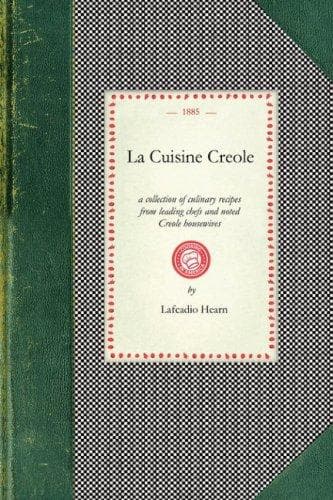
La cuisine creole
1885Lafcadio Hearn · 106 readable pages · 516 recipe records · regional household cookbook
From the librarian's dossier · AI-generated, grounded in the scanned text
La Cuisine Creole (1885) is a New Orleans cookbook compiled by Lafcadio Hearn, presenting itself as a record of the city's distinctive blended culinary heritage drawing on American, French, Spanish, Italian, West Indian, and Mexican traditions. Organized in the manner of a comprehensive household manual, it moves from soups and stocks through fish and seafood, sauces, entrees, poultry and game, vegetables, pickles and salads, breads and yeasts, cakes, puddings and preserves, beverages and confections, and finally general household hints with an index. The book contains 516 anchored food records, reflecting its scope as a working kitchen reference rather than a narrow specialty text. Its introduction explicitly frames Creole cookery as a matter of careful method rather than costly ingredients, and the recipes throughout, from turtle soup and gombo to red snapper a la Chambord, illustrate a cuisine built on economical use of local ingredients alongside more elaborate French-derived preparations for formal dining. The inclusion of invalid cookery, home preservation, wine service guidance, and even soap-making and house-cleaning instructions shows a book meant to serve an entire household's domestic needs, not just its cooking. Modern readers will find it a rich primary source for understanding both the cuisine and daily domestic life of 19th-century New Orleans.
The book is arranged as a sequence of culinary categories beginning with an introduction and soup section (section 1), followed by fish, seafood, and a large compendium of sauces (section 2), entrees and meats (section 3), poultry, game, and vegetables (section 4), pickles, salads, and yeast (section 5), breads and cakes (section 6), further cakes and desserts (section 7), puddings, preserves, and fruit beverages (section 9), beverages, confections, and elaborate main dishes (section 10), and finally cooking hints, house-cleaning advice, and an index (section 11). The organization follows the logic of a full meal and household reference, moving from stocks and soups toward proteins, vegetables, baked goods, sweets, and drinks, before closing with practical domestic advice and an index for navigation.
Recipes from this book
516 records extracted from the text, showing the first 50 in reading order. Each links to a modern interpretation.
Read the book
106 readable pages. A dot marks pages with recipe records.