
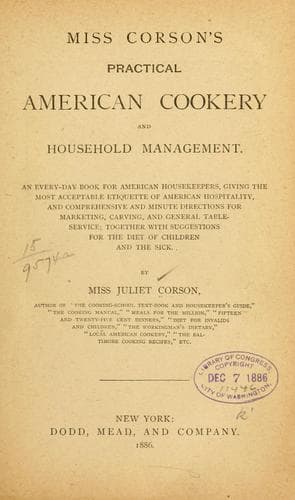
Miss Corson's practical American cookery and household management
1885Juliet Corson · 312 readable pages · 685 recipe records · general household cookbook with etiquette and domestic management guide
From the librarian's dossier · AI-generated, grounded in the scanned text
Miss Corson's Practical American Cookery and Household Management (1885) is Juliet Corson's ambitious attempt to document American cooking and domestic life at the request of the U.S. Commissioner of Education. Corson gathered recipes and regional specialties from correspondents across the country, assembling them into a guide meant to serve ordinary households with clear, precise instructions. The book moves well beyond recipes alone, covering kitchen design and maintenance, pantry and cellar organization, dairy care, meat selection, and the full etiquette of formal and informal entertaining, from elaborate a la Russe dinners to picnics and children's meals. The recipe sections that follow are extensive, covering soups, fish, shellfish, meats, poultry, game, vegetables, breads, pastries, frozen desserts, preserves, and beverages, with a closing section on invalid and children's diets. Readers today will find both a working cookbook and a window into the domestic ideals and social choreography of upper-middle-class American households in the 1880s. Corson's stated intent to make cooking accessible to "ordinary intelligence" gives the book a didactic, explanatory tone rare in period cookbooks, walking readers through the reasoning behind techniques rather than simply listing steps. The book is as much a household management manual as a cookbook, and its scope makes it a useful record of one vision of American domestic life in the late nineteenth century.
The book opens with a preface explaining its origins and methodology (section 1), then moves through household management topics: kitchen fitting, pantry and cellar organization, dairy care, and meat selection (sections 2-3). A long stretch covers cooking methods and carving (sections 3-5), followed by extensive material on dining room furnishing, table settings, formal dinner service styles, and entertaining etiquette for occasions ranging from grand dinners to garden parties and family breakfasts (sections 5-10). The recipe chapters proper begin around section 10 and proceed in a course-like sequence mirroring formal menus: soups (sections 10-12), fish and shellfish (sections 12-14), eggs and relishes (sections 14-15), meat and poultry entrees and removes (sections 16-19), game and poultry (sections 20-21), vegetables (sections 22-24), then an extended dessert sequence covering cakes, puddings, pastry, pies, breads, frozen desserts, and preserves (sections 24-30). The book closes with beverages and a dedicated section on diet for invalids and children (sections 31-32). Section numbering in the source skips from 22 to 24, suggesting a gap in the available material.
Recipes from this book
685 records extracted from the text, showing the first 50 in reading order. Each links to a modern interpretation.
Read the book
312 readable pages. A dot marks pages with recipe records.