
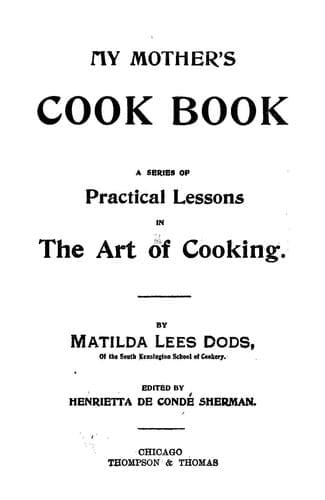
My mother's cook book
1902Matilda Lees Dods · 106 readable pages · 296 recipe records · general household cookbook
From the librarian's dossier · AI-generated, grounded in the scanned text
My mother's cook book (1902) by Matilda Lees Dods is a comprehensive American household cookery manual organized around the daily and formal meals of an upper-middle-class kitchen. Its nearly three hundred anchored food records range across shellfish and fish, meat divisions organized by cooking method, vegetables and salads, souffles and puddings, sauces, frozen desserts, pastries and baked goods, organ meats and eggs, and finally carving instruction paired with household hints. The recipes reflect a kitchen with access to game, organ meats, imported condiments like Worcestershire sauce and mushroom catsup, and elaborate molded desserts requiring gelatin, steaming, and careful technique. The book reads less as a simple recipe list than as an instructional guide, with the author frequently pausing to explain technique: browning meats properly, whipping egg whites to a froth, testing cakes with a skewer, chilling butter for pastry. Toward its end the book widens its scope beyond cookery into carving guidance and general household management, including pest control and cleaning remedies, suggesting its intended audience managed a full domestic establishment rather than cooking alone. For the modern reader, this book offers a detailed window into formal, labor-intensive turn-of-the-century American (with strong British-influenced) cookery and household practice.
The book proceeds through major divisions of a formal meal and household routine. Sections 2 through 4 cover shellfish, fish, and an extended meat sequence broken into numbered 'divisions' (first through sixth) covering roasts, boiled meats, stews, cold-meat dishes, and broiled or fried preparations, with game recipes appearing in section 4. Sections 5 and 6 turn to refined meat entrees (quenelles, timbales) and then vegetables and salads, followed by croquettes and fritters. Sections 7 and 8 are devoted to souffles, puddings, sauces (both savory and sweet), and frozen desserts, creams, and jellies. Section 9 covers pastry, pies, breads, and cakes. Section 10 returns to miscellaneous practical fare: organ meats, eggs, staples like rice and oatmeal, and clarified fat. Section 11 closes the book with carving instructions for meat and game followed by a distinct household-hints section on pest control, cleaning, and domestic remedies.
Recipes from this book
296 records extracted from the text, showing the first 50 in reading order. Each links to a modern interpretation.
Read the book
106 readable pages. A dot marks pages with recipe records.