
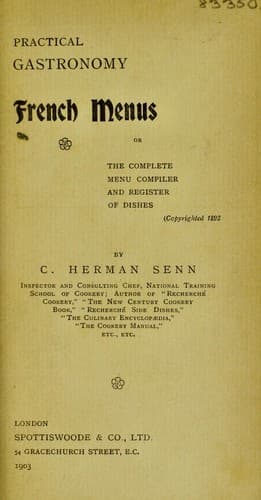
Practical gastronomy
1903Charles Herman Senn · 126 readable pages · 0 recipe records · menu-composition and reference cookbook (classical French culinary dictionary and course-by-course recipe guide)
From the librarian's dossier · AI-generated, grounded in the scanned text
Practical Gastronomy is a 1903 menu-composition and reference handbook by Charles Herman Senn, aimed at cooks and household managers seeking to master the vocabulary and structure of formal French-influenced dining. Rather than a simple recipe collection, the book functions as a guide to building correct, elegant menus, pairing an English-French culinary glossary and pronunciation guide with hundreds of named dishes organized by course. It moves systematically through the full architecture of a formal meal: hors-d'oeuvre, soups, sauces, fish, meats, poultry, game, cold entrees, vegetables, salads, sweets, savouries, and ices, closing with notes on dessert and coffee service. Recipes are typically given with French titles and English translations, emphasizing garnishes, sauces, and classical techniques such as braising, larding, and gratin work. The book reflects the elaborate, multi-course dining culture of the early 1900s, where dishes were often named for people, places, or occasions and variety across a season was prized. For the modern reader it offers a window into Edwardian-era haute cuisine conventions, the formal grammar of menu writing, and the sheer range of ingredients, from game birds and offal to truffles and glace desserts, considered standard fare in fine dining of the period.
The book opens with front matter (section 1) covering purpose, a seasonal food chart, an English-French glossary, pronunciation guidance, and specimen menus. It then proceeds course by course: supper menus and hors-d'oeuvre (section 2), soups and the start of sauces (section 3), sauces continued and fish (section 4), meats including beef and veal (section 6), lamb, mutton, pork, and early poultry (section 7), game birds and more poultry (section 8), four-footed game, cold entrees, removes, and vegetables (section 9), vegetables, potatoes, punches, and salads (section 10), salads and sweet entremets (section 11), souffles, omelettes, cakes, pastry, and savouries (section 12), and finally omelets, ices, and dessert/coffee service (section 13). Section 5 is not present in the supplied material. Entries throughout are organized alphabetically or by category within each course, typically pairing a French title with an English translation and a brief description of ingredients and method.
Read the book
126 readable pages. A dot marks pages with recipe records.