
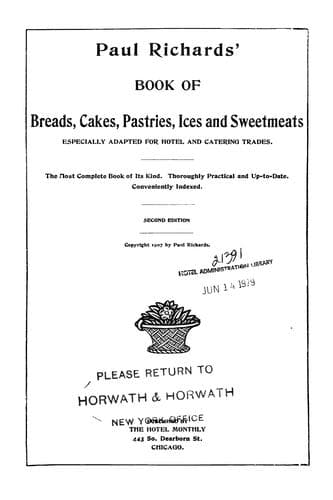
Paul Richards' book of breads, cakes, pastries, ices and sweetmeats
1907Paul Richards · 195 readable pages · 568 recipe records · professional baking and pastry trade manual
From the librarian's dossier · AI-generated, grounded in the scanned text
Paul Richards' Book of Breads, Cakes, Pastries, Ices and Sweetmeats (1907) is a large professional-scale baking manual aimed squarely at hotel, restaurant, and bakeshop workers, though home cooks could use it as well. Drawing on nearly 570 anchored food records, it moves systematically through pies and tarts, an enormous range of cakes and small fancy pastries, hot and cold puddings, molded creams and gelatin desserts, frozen creams and ice creams, and then a substantial treatise on breadmaking, rolls, coffee cakes, and griddle goods, closing with confectionery, candy work, and practical trade tips. The book reflects the continental (especially German, Austrian, and French) influence on American commercial baking of the era, with named specialties like Vienna tourtes, pumpernickel, brioche, and Parker House rolls sitting alongside American standards like Boston brown bread and Indian pudding. Numbered recipes and cross-references between mixtures, fillings, and icings suggest a working reference meant to be consulted repeatedly rather than read cover to cover. An alphabetical index and publisher advertisements for companion trade handbooks round out the volume, underscoring its identity as a professional culinary reference from the Hotel Monthly Handbook series. Modern readers will find a detailed window into turn-of-the-century bakeshop practice, ingredient sourcing, and dessert fashion, alongside recipes that assume trade knowledge the text does not always spell out.
The book is organized as a sequence of baking and pastry categories rather than a single alphabetical dictionary. It opens with pies and tarts (section 3), then a long run of cakes, tourtes, small fancy pastries, and cookies (sections 5 and 6). Puddings, sauces, and cold desserts follow across several sections (7, 8, 9), covering hot steamed and baked puddings, then molded creams, Charlotte Russe variations, Bavarian creams, and jellies. Frozen desserts and ice creams appear in section 12, which then pivots into an extensive breadmaking treatise covering flour, yeast, and fermentation systems. Sections 13 and 14 give detailed bread and roll formulas organized by national style (French, Vienna, American, rye, pumpernickel) and by product type (rolls, dinner breads, soup sticks). Section 15 covers leavened coffee cakes, holiday breads, fried doughs, muffins, biscuits, and waffles. Section 17 turns to confectionery and candy work, egg and fruit preservation. Section 18 mixes miscellaneous recipes with an alphabetical index spanning many pages, and section 20 consists of publisher advertisements for companion professional handbooks. Recipes are numbered throughout and frequently cross-reference earlier numbered mixtures, fillings, and icings, indicating a modular reference system built for repeated consultation in a working bakeshop.
Recipes from this book
568 records extracted from the text, showing the first 50 in reading order. Each links to a modern interpretation.
Read the book
195 readable pages. A dot marks pages with recipe records.