
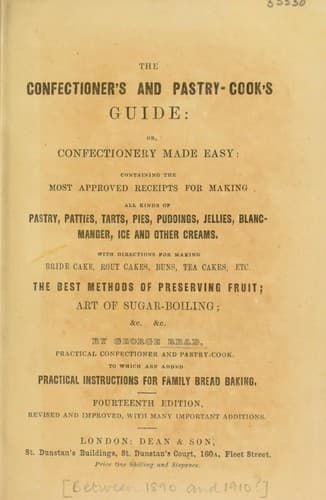
The confectioner's and pastry-cook's guide, or, Confectionery made easy ...
1890George Read · 50 readable pages · 136 recipe records · professional confectionery and pastry trade manual
From the librarian's dossier · AI-generated, grounded in the scanned text
This is a late-19th-century professional trade manual for confectioners and pastry cooks, published in 1890 under the title The Confectioner's and Pastry-Cook's Guide, or, Confectionery Made Easy. Attributed to George Read, the book is a working reference for producing pastry, savory pies, cakes, frozen and jellied desserts, preserves, and sugar confectionery at scale, likely for a bakehouse or confectionery shop rather than an ordinary household kitchen. Readers will find detailed technique-driven instruction, from keeping butter firm for puff paste in warm weather to boiling sugar to precise degrees for lozenges and rock candy. The book moves systematically from foundational pastry technique through meat pies and forcemeats, into elaborate cold and hot raised pies, then into cakes, frozen creams and jellies, fruit preserving, and finally sugar confections and household bread. Along the way it offers glimpses of period technique: gravies and aspics for pies, elaborate wedding cake icing, and cautionary notes on coloring agents. With 136 anchored food records across its sections, this is a dense, recipe-heavy text aimed at practitioners with existing kitchen skill. Modern readers will find it a valuable window into commercial Victorian confectionery and pastry practice, though the instructions assume trade knowledge the text itself does not always spell out.
The book is organized into four surviving sections that follow a logical progression of confectionery and pastry trade work. Section 1 opens with foundational techniques (butter preparation, puff paste, baking temperatures) before giving specific pastry recipes and savory pies and patties. Section 2 continues with meat pie work, forcemeats, gravies and aspic jellies, then moves into tarts, decorative pastries, and almond-based cakes and biscuits including wedding cakes. Section 4 shifts to frozen and jellied desserts (ices, creams, jellies, blancmanger, trifle) and then to preserving techniques (jams, marmalades, bottled fruit) and the fundamentals of sugar boiling. Section 5 continues the sugar confectionery work (rock sugar, lozenges, drops, comfits, meringues) with notes on flavoring and coloring, then closes with household bread recipes and an index. Note that a section 3 is not present among the provided summaries, suggesting a gap in the material available for this dossier.
Recipes from this book
136 records extracted from the text, showing the first 50 in reading order. Each links to a modern interpretation.
Read the book
50 readable pages. A dot marks pages with recipe records.