
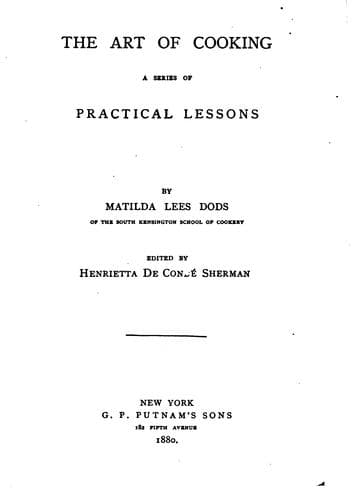
The art of cooking
1880Matilda Lees Dods · 102 readable pages · 287 recipe records · general household cookbook
From the librarian's dossier · AI-generated, grounded in the scanned text
The Art of Cooking is an 1880 household cookbook by Matilda Lees Dods, who identifies herself as trained at the South Kensington School of Cookery. In her preface she frames cookery as both a science and an art worthy of systematic study, and the book that follows delivers on that promise with a highly organized progression through soups, shellfish, fish, meats, vegetables, salads, fried dishes, souffles, puddings, sauces, ices and jellies, pastries, breads, cakes, breakfast dishes, and miscellaneous preparations. The recipes are detailed and technical, frequently specifying exact quantities, cooking times, and temperatures, and offering guidance on trussing, larding, sauce-making, and other period techniques. The book closes with an index and a notable essay warning against alum-based baking powders, followed by advertising material for a specific baking powder brand and for granite ironware. Modern readers will find a window into upper-middle-class Victorian American or Anglo-American domestic cookery, with an emphasis on formal technique, elaborate entrees, and a clear concern for food purity. The mix of recipes, household science, and commercial endorsements makes this both a cookbook and a small artifact of contemporary food commerce and consumer advocacy.
The book proceeds through eleven mechanically gated sections that track a logical culinary progression. It opens with a preface and table of contents (section 1), then moves through soups and purees (section 1), shellfish and fish (section 2), and an extended sequence of meat preparations spanning roasting, boiling, cold dishes, broiling, game, and refined entrees (sections 2 through 5). Vegetables, salads, croquettes, and fritters follow (sections 5 and 6), then souffles and a long run of puddings (sections 7 and 8), sauces and frozen desserts (section 8), pastries, breads, and cakes (section 9), and finally breakfast dishes, beverages, and miscellaneous items with an index (section 10). The book closes with a distinct short section (section 11) containing an anti-alum essay, baking powder testimonials, and an ironware advertisement, which reads as appended promotional matter rather than core recipe content.
Recipes from this book
287 records extracted from the text, showing the first 50 in reading order. Each links to a modern interpretation.
Read the book
102 readable pages. A dot marks pages with recipe records.