
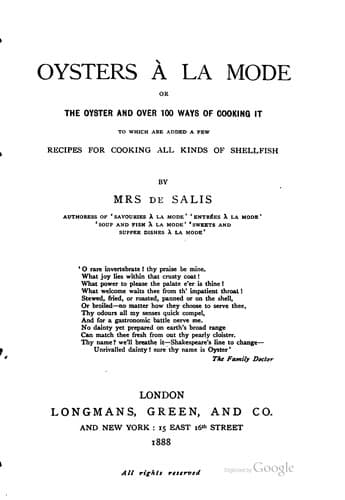
Oysters à la mode, or, The oyster and over 100 ways of cooking it
1888Harriet Anne de Salis · 34 readable pages · 122 recipe records · specialized single-ingredient cookbook (shellfish, focused on oysters)
From the librarian's dossier · AI-generated, grounded in the scanned text
Oysters à la mode (1888) is a specialized Victorian cookbook by Harriet Anne de Salis devoted almost entirely to the oyster, delivering on its subtitle's promise of over 100 ways of preparing it. The book opens with a discursive introduction covering oyster biology, regional reputations (English oysters from Essex and Suffolk are singled out as superior), and contemporary debate over whether oysters are wholesome and easy to digest, citing figures such as Brillat-Savarin and Dr. Spencer Thomson. From there the book becomes almost entirely recipe-driven, moving through raw preparations, broiled and boiled dishes, sauces, soups, souffles, and elaborate molded or aspic presentations, many bearing French names with English translations. In its later pages the book broadens its scope beyond oysters to related shellfish, including clams, cockles, crabs, crayfish, mussels, prawns, shrimp, scallops, and periwinkles, closing with a comprehensive index. The book is a useful window into upper-middle-class Victorian entertaining, showing how a single ingredient could be elevated into a full repertoire of dishes for both plain family meals and formal dinners. Modern readers interested in food history, Victorian dining customs, or the culinary versatility of shellfish will find this a compact but rich period document.
The book is organized in three gated sections that move from general discussion to recipe compilation. Section 1 begins with a preface and introduction addressing oyster natural history, regional quality, and health debates, then transitions into the first block of recipes, roughly 30 preparations covering openings, simple cooked dishes, and elaborate constructions. Section 3 continues the recipe sequence with sauces, soups, souffles, scalloped and aspic preparations, and then widens to include other shellfish such as clams, cockles, crabs, crayfish, and lobsters. Section 4 concludes with mollusk and crustacean recipes centered on mussels, prawns, shrimp, scallops, and periwinkles, ending with a comprehensive index that covers oyster preparations and other shellfish dishes throughout the book. The overall arrangement suggests a front-loaded introduction followed by a long, loosely themed recipe catalogue rather than a rigid alphabetical or course-based structure.
Recipes from this book
122 records extracted from the text, showing the first 50 in reading order. Each links to a modern interpretation.
Read the book
34 readable pages. A dot marks pages with recipe records.