
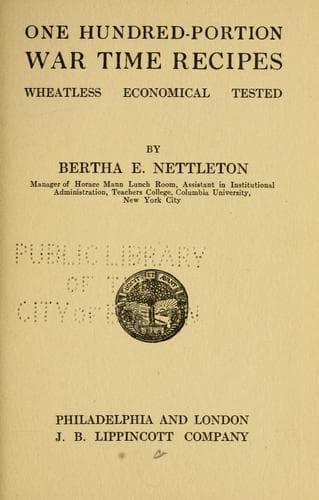
One hundred-portion war time recipes
1918Bertha E. Nettleton · 18 readable pages · 0 recipe records · institutional wartime cookbook
From the librarian's dossier · AI-generated, grounded in the scanned text
Published in 1918 at the height of American mobilization for the First World War, One Hundred-Portion War Time Recipes is a specialized institutional cookbook by Bertha E. Nettleton. Unlike household cookbooks of the era, this volume was built for feeding large groups at once, with every recipe scaled to yield one hundred servings for use in military hospitals, canteens, and community kitchens. The book reflects the food conservation ethos of wartime America, favoring economical ingredients, minimal seasoning, and substitutions such as butterine for butter and alternative flours like barley, corn, and rice. Organized into two main sections, it moves from soups, meats, fish, and meat substitutes through sauces, salads, dressings, and desserts. Recipes are given in weights rather than standard kitchen measures, reflecting the use of scales and platform balances in institutional kitchens rather than home tools. This is a practical, purpose-built manual rather than a literary or narrative cookbook, offering a window into the logistics of mass feeding during a period of national food restriction. Modern readers will find it valuable as a historical document of wartime cooking culture, institutional food service, and early twentieth-century approaches to nutrition and economy at scale.
The book is organized into two sections. Section 1 opens with an introduction explaining the rationale for one hundred-portion recipes and includes a contents listing, followed by soups, meat dishes, chicken and ham dishes, fish recipes, and meat substitutes such as baked beans, vegetable loaves, and rice croquettes. Section 2 continues with sauces (including lemon, Mexican, Spanish, tomato, and white sauce variations), then moves into salads, salad dressings, and finally desserts and baked goods such as puddings, gelatine dishes, cakes, cookies, breads, and muffins. The organization follows a typical meal-course progression, from soups and mains through sauces and accompaniments to sweets.
Read the book
18 readable pages. A dot marks pages with recipe records.